On Wednesday, February 4, 2026, President of Romania Nicușor Dan published a statement addressing references to Romania contained in the Preliminary Report of the U.S. House of Representatives Judiciary Committee. His message clarifies the context of those references and reaffirms Romania’s institutional position regarding the annulment of the 2024 presidential elections and the broader issue of foreign interference in democratic processes.
According to the President, Romania is not the subject of the U.S. congressional report. Mentions of the country appear only in a contextual capacity, within a much larger debate focused on freedom of expression. The sections referencing Romania do not constitute a legal judgment or formal assessment of Romanian institutions or electoral processes.
The passages in the report discussing Romania’s 2024 presidential elections are described as strictly descriptive and based only partially on the response of a single private company, TikTok. These references reflect one platform’s technical reporting and cannot replace or serve as a substitute for a legal or constitutional evaluation. TikTok itself has publicly acknowledged that it proactively identified covert influence networks, removed tens of thousands of fake accounts and interactions, and banned hundreds of accounts impersonating presidential candidates.
President Dan emphasized that the decision to annul the elections was a domestic legal act taken to protect the constitutional order in the face of an asymmetric threat. That decision was grounded in assessments by Romania’s national security institutions and exercised under the authority of the Constitutional Court of Romania.
The Constitutional Court’s ruling relied on documentation indicating, without ambiguity, a severe distortion of equal opportunity among candidates and the large-scale corruption of the electoral campaign by a single candidate. According to the decision, this distortion involved the non-transparent and illegal use of digital technologies and artificial intelligence, as well as undeclared campaign financing, including in the online environment.
The statement also places Romania’s experience within a wider European security context. Official reports by NATO, the European Union, and the Government of the United Kingdom have documented interference by the Russian Federation in electoral processes across Europe, including Romania. The President described this interference as part of a long-running hybrid campaign aimed at destabilizing democratic systems, extending far beyond any single social media platform.
The message concludes by reaffirming Romania’s institutional strength and democratic foundations. Decisions taken by responsible authorities in accordance with the Constitution and existing laws must be respected. Romania’s commitment to the rule of law, transparency, freedom of expression, and the integrity of electoral processes remains firm. The country also reiterates its ongoing commitment to its allies and strategic partners.
The statement serves both as clarification and as a reaffirmation of Romania’s democratic resilience in the face of modern information and security threats.
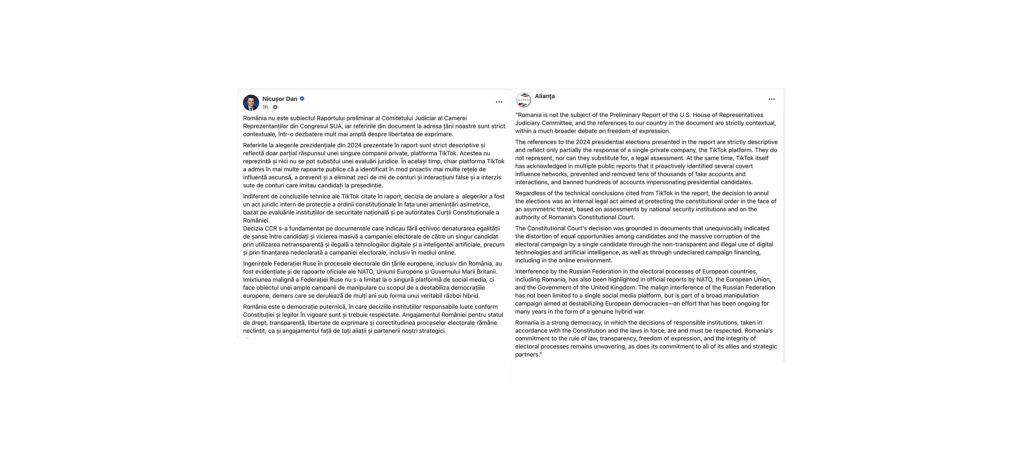
Full text in Romanian and English below
Romania is not the subject of the Preliminary Report of the U.S. House of Representatives Judiciary Committee, and the references to our country in the document are strictly contextual, within a much broader debate on freedom of expression.
The references to the 2024 presidential elections presented in the report are strictly descriptive and reflect only partially the response of a single private company, the TikTok platform. They do not represent, nor can they substitute for, a legal assessment. At the same time, TikTok itself has acknowledged in multiple public reports that it proactively identified several covert influence networks, prevented and removed tens of thousands of fake accounts and interactions, and banned hundreds of accounts impersonating presidential candidates.
Regardless of the technical conclusions cited from TikTok in the report, the decision to annul the elections was an internal legal act aimed at protecting the constitutional order in the face of an asymmetric threat, based on assessments by national security institutions and on the authority of Romania’s Constitutional Court.
The Constitutional Court’s decision was grounded in documents that unequivocally indicated the distortion of equal opportunities among candidates and the massive corruption of the electoral campaign by a single candidate through the non-transparent and illegal use of digital technologies and artificial intelligence, as well as through undeclared campaign financing, including in the online environment.
Interference by the Russian Federation in the electoral processes of European countries, including Romania, has also been highlighted in official reports by NATO, the European Union, and the Government of the United Kingdom. The malign interference of the Russian Federation has not been limited to a single social media platform, but is part of a broad manipulation campaign aimed at destabilizing European democracies—an effort that has been ongoing for many years in the form of a genuine hybrid war.
Romania is a strong democracy, in which the decisions of responsible institutions, taken in accordance with the Constitution and the laws in force, are and must be respected. Romania’s commitment to the rule of law, transparency, freedom of expression, and the integrity of electoral processes remains unwavering, as does its commitment to all of its allies and strategic partners.